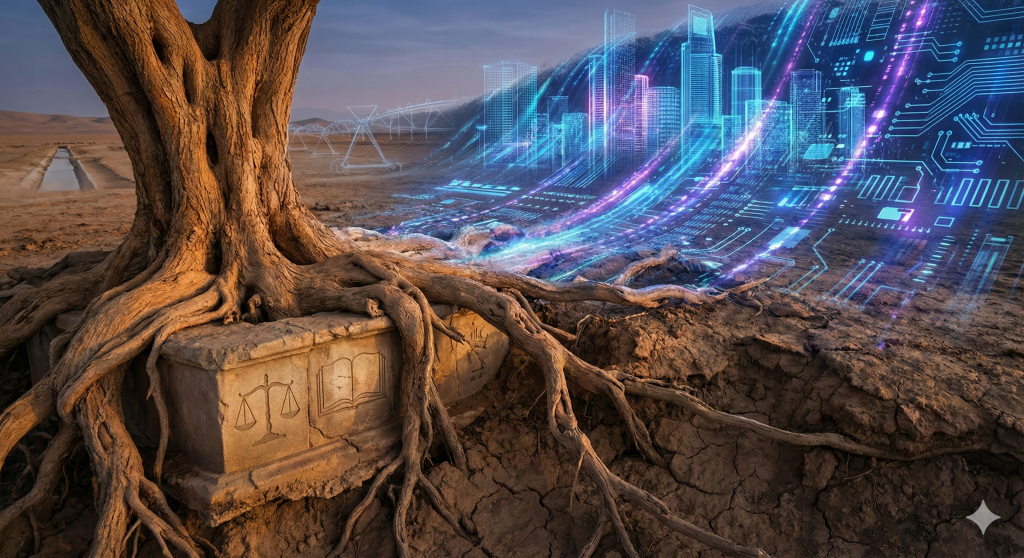

Peter Drucker said, “The key to change management is defining what not to change.”
The Age of Artificial Intelligence promises to revolutionize the legal profession. and justice systems. Richard Susskind suggests that: “We will experience more change to our personal lives and legal services in the next two decades than we have in the past two centuries.”
The discussions about AI remind me of an article about “innovations” in agriculture. From the Discovery News article: Peruvian Desert once a Breadbasket:
. . .In less than two thousand years, the people went full circle and ended up eating what their ancestors had, but without the huarango forests. To this day, the land is barren, with only the ghostly outlines of irrigation canals to suggest that the land once supported an agrarian society.
Throughout human history unsustainable agricultural practices have turned fragile ecosystems into wastelands and left people starving. During the Dust Bowl, American farmers learned the consequences of removing the deep rooted grasses from the Great Plains when the soil blew away in tremendous dust storms. Icelandic shepherds learned that the sheep rearing practices their ancestors used on the European mainland destroyed the thin soils of their island and left them with starving herds and little to eat.
The ancient inhabitants of what is now Peru also learned the unhappy consequences of farming in a delicate ecosystem. The Ica Valley, near the coast of southern Peru and the famous Nazca lines, is now a barren desert, but was once a fertile floodplain, anchored by the roots of the huarango tree.
People were able to raise a variety of crops there for several centuries. But intensive agriculture in pre-conquest times led to ecosystem collapse. The history of the land was recently reconstructed by bioarcheologist David Beresford-Jones of the University of Cambridge by looking at plant remains left in ancient garbage heaps.
Beresford-Jones and a team of archeologists studied plant remains associated with settlement sites spanning roughly 750 B.C. to 1000 A.D. They observed the change as the valley inhabitants went from eating mostly gathered foods, to a period of intense agriculture, then back again to surviving on what they could eke out of nature’s diminished bounty.
The farmers inadvertently crossed an ecological threshold and the changes became irreversible,” says Dr. David Beresford-Jones of the University of Cambridge.
Farming the Ica Valley was possible because of the huarango tree woodland, which literally held the floodplain together. The roots of the tree physically anchored the soils and protected the ground from erosion. The trees also maintained fertility by fixing nitrogen from the air and keeping moisture in the soil.
Before we revolutionize the system, we must examine what are the institutions that hold the justice ecosystem together. I would tender that civil juries are one such institution, a necessary infrastructure for our system of justice.
Theresa Leitch writes about another possible anchor institution: the law library. She writes In an article entitled: “Don’t Close the Book on Libraries: Why Space Still Matters:
So I get why people ask whether we still need physical library space?
The answer is a resounding yes.
Library spaces remain vital, not just as repositories of knowledge, but as dynamic environments that foster focus, collaboration, equity, and community.
We need more analysis like this. What parts of the pre-AI justice system deserve to remain? What greater principles than “efficiency” and “speed” demand our priority?
 TomorrowLawyer: Scholar, Tribune, & Operator
Leave a comment